
Can AI Systems Be GxP Compliant?
AI is moving fast in pharma. Companies are using it for adverse event detection, clinical trial monitoring, regulatory submissions, manufacturing quality control, and more.
But there is a question that keeps getting pushed to the side: can an AI system actually be GxP compliant?
The short answer is yes, but not automatically, and not easily. An AI system can meet GxP requirements, but only if it is built, validated, and governed the right way from the start.
This blog breaks down what GxP compliance actually means for AI, the real problems pharma teams run into, and what a proper path to compliance looks like.
What Does GxP Compliant Mean?
GxP is a broad term covering a family of quality guidelines used in regulated industries like pharmaceuticals and medical devices. It includes GMP (manufacturing), GCP (clinical trials), GLP (laboratory), GVP (pharmacovigilance), and more.
For a system, traditional or AI – to be GxP compliant, it has to meet four core requirements:
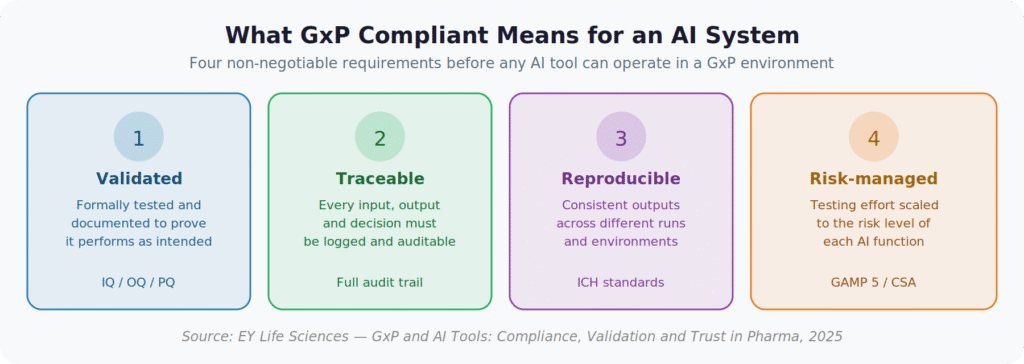
Infographic 1: What GxP Compliant Means for an AI System
- Validated — formally tested and documented to prove it does what it is supposed to do
- Traceable — every input, output, and decision must be logged and auditable
- Reproducible — consistent outputs under the same conditions
- Risk-managed — testing depth scaled to the risk level of the function
| Traditional software meets these requirements through CSV — Computer System Validation. AI creates a new problem: its outputs are not always deterministic. The same input can produce different outputs. That breaks the traditional validation model. |
The Real Problems Pharma Teams Face
Deploying AI in a GxP environment sounds straightforward until you try to actually do it. Here is where things break down in practice.
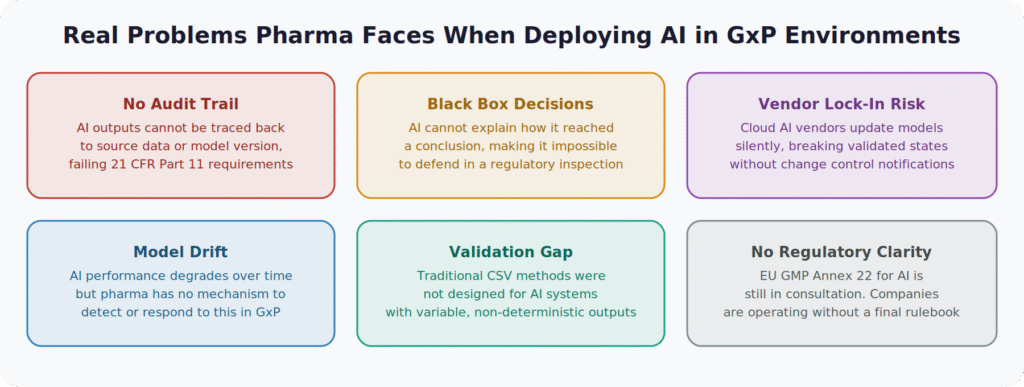
Infographic 2: Real Problems Pharma Faces When Deploying AI in GxP Environments
Problem 1 — No Audit Trail
Most commercial AI tools, including large language models and analytics platforms, do not generate a usable audit trail by default. There is no log of which version of the model produced a specific output, what data it used, or how it reached its conclusion.
Under 21 CFR Part 11 and EU GMP Annex 11, an audit trail is not optional. It is a regulatory requirement. If an AI tool cannot show inspectors exactly what happened and why, it cannot be used in a GxP-regulated process.
RxCloud’s Security & Risk Audits and QA Consulting services help pharma organizations identify exactly these kinds of gaps before a regulator does.
Problem 2 — Black Box Decisions
A pharmacovigilance AI that flags a safety signal cannot just say “this looks risky.” It has to be able to show why, what data points contributed to that conclusion, and how confident the system is in that output.
Most off-the-shelf AI tools cannot provide that level of explainability. And without explainability, there is no way to defend an AI-assisted decision during a regulatory inspection or a safety review.
This is not just a compliance issue. It is a patient safety issue. Regulators know this, which is why both the EU AI Act and the draft EU GMP Annex 22 are pushing hard on explainability requirements.
Problem 3 — Vendor Updates Break Validated States
One of the most common problems pharma teams discover too late: a cloud-based AI vendor pushes a model update quietly, and the system that was validated last month is now running on a different version.
Under GxP, any change to a validated system requires change control, a formal review and re-validation before the updated system goes back into production. Most AI vendors do not have pharmaceutical change control built into their update processes.
This is a structural gap between how AI vendors operate commercially and what Computer System Validation (CSV) requires. Companies need supplier qualification agreements that specifically address change notification and version control before connecting any AI tool to a GxP process.
Problem 4 — Traditional CSV Was Not Built for AI
CSV was designed for deterministic software — systems where the same input always produces the same output. AI does not work that way.
According to EY’s 2025 analysis of GxP and AI tools, the traditional validation paradigm where a specific input produces one predefined output is no longer sufficient or appropriate for AI-driven systems. Instead, validation must account for acceptable ranges of variation and confirm outputs remain accurate within defined boundaries.
This means pharma teams need a fundamentally different approach, one that tests across ranges of inputs, evaluates output quality against defined criteria, and accounts for the probabilistic nature of AI.
RxCloud’s QMS Consulting and Test Automation services are relevant here helping pharma organizations build the testing infrastructure that modern AI validation requires.
Problem 5 — The Regulatory Framework Is Still Catching Up
The EU’s GMP Annex 22, which specifically addresses AI in pharmaceutical manufacturing, was only published for public consultation in mid-2025. It is not yet finalized.
This leaves pharma companies in a difficult position: they know regulators expect AI to meet GxP standards, but the exact requirements are still being written. Companies that wait for final guidance before acting will already be behind when it is published.
The practical answer is to follow the existing frameworks, EU GMP Annex 11, 21 CFR Part 11, GAMP 5 principles, and the EU AI Act risk classification and document every decision carefully. GMP Audits and GCP Audits that specifically cover AI-integrated systems are becoming more important as this regulatory picture sharpens.
What the Path to GxP Compliant AI Actually Looks Like
There is no shortcut to a GxP compliant AI system. But there is a clear, structured path.
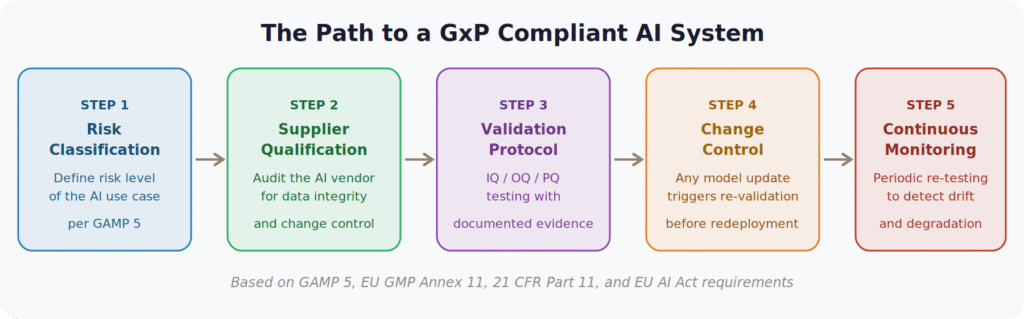
Infographic 3: The Five-Step Path to a GxP Compliant AI System
- Step 1 — Risk classification: Define the risk level of each AI use case using GAMP 5 principles
- Step 2 — Supplier qualification: Audit the AI vendor for data integrity commitments, change notifications, and uptime
- Step 3 — Validation protocol: Run IQ / OQ / PQ testing with documented evidence that the system performs as intended
- Step 4 — Change control: Any model update triggers re-validation before the system goes back into a GxP process
- Step 5 — Continuous monitoring: Periodic re-testing to detect model drift and performance degradation over time
| One emerging approach that is gaining traction: using AI to test AI. Automated test generation can create thousands of input scenarios, feed them into the AI system, and evaluate outputs against defined quality criteria — covering far more ground than manual testing alone. Human experts still review the critical results before release decisions are made. |
RxCloud’s RxAuditor accelerator is built to support exactly this kind of structured, documented audit readiness, helping pharma teams manage GxP audit processes in a way that holds up under regulatory scrutiny, including as AI becomes part of the systems being audited.
Frequently Asked Questions
What does GxP compliant mean for an AI system?
It means the AI system has been formally validated, generates a full audit trail, produces consistent and reproducible outputs, and is governed by change control procedures — meeting the same quality and documentation standards required of any regulated software in pharma.
Can AI systems be used in GxP-regulated processes?
Yes, but only if they are properly validated under applicable frameworks such as EU GMP Annex 11, 21 CFR Part 11, and GAMP 5. The challenge is that most commercial AI tools are not built with GxP requirements in mind, so significant validation and governance work is needed before they can be used in regulated environments.
What is the biggest compliance risk when deploying AI in pharma?
The lack of an audit trail is the most immediate risk. Regulators need to see exactly what the system did, when, and why. AI tools that cannot produce that documentation cannot be used in GxP processes regardless of how accurate their outputs are.
How does EU GMP Annex 22 affect AI in pharma?
Annex 22 is the EU’s draft regulation specifically addressing AI in pharmaceutical manufacturing. As of mid-2025, it is still in public consultation and limited to AI tools using static content. Companies should follow it closely, but in the meantime, Annex 11 and GAMP 5 remain the applicable frameworks.
Does RxCloud help with GxP AI validation?
RxCloud’s services in CSV, QA Consulting, QMS, GMP Audits, and Test Automation are all directly relevant to pharma organizations building GxP-compliant AI environments. RxCloud does not build AI tools, but it provides the compliance infrastructure that makes them deployable in regulated settings.
The Bottom Line
Most pharma companies are not choosing to deploy AI without thinking about GxP. They simply underestimate how much work it takes to make an AI system genuinely compliant and how different that work is from validating traditional software.
The regulatory frameworks are tightening. EU GMP Annex 22 is coming. The FDA is watching. And auditors are beginning to ask about AI governance in inspections that never used to touch it.
Companies that treat GxP-compliant AI as a validation checkbox will struggle. Companies that treat it as a proper discipline, with structured protocols, supplier governance, continuous monitoring, and documented evidence, will be in a very different position when that inspection happens.
| Want to understand where your current AI systems stand against GxP requirements? Talk to RxCloud about audit and quality engineering services built specifically for life sciences environments. |