
Pharmaceutical companies are under enormous pressure to move faster. AI tools promise exactly that — quicker literature reviews, faster data analysis, sharper clinical insights. So employees use them. Every day, without much thought.
And that is where the problem starts.
A recent industry study found that only 17% of pharmaceutical organizations have automated controls to stop sensitive data from leaking through AI platforms. The remaining 83% are running on a combination of training sessions, email warnings, and hope.
In an industry where a single leaked molecular structure can destroy years of R&D investment, that is not a strategy. It is exposure.
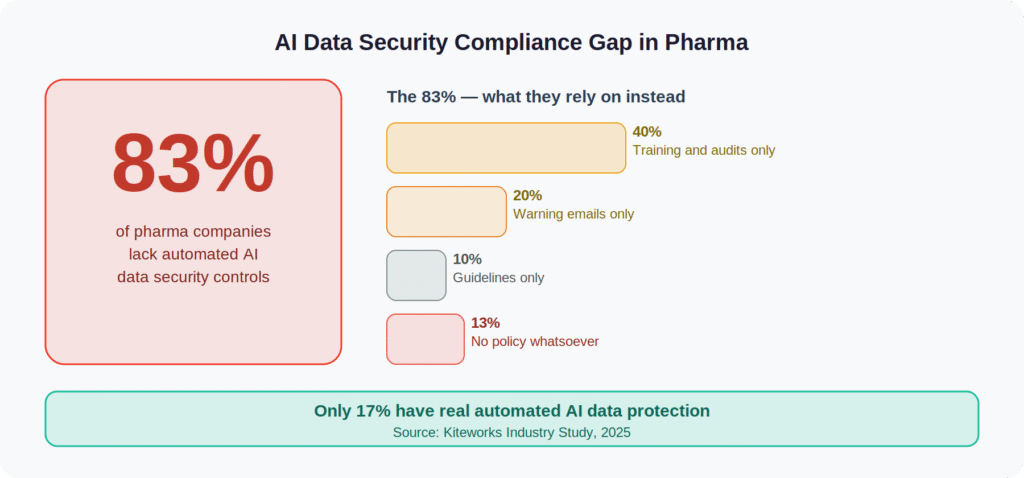
Infographic 1: The AI Data Security Compliance Gap in Pharma
Why AI Data Security in Pharma Is Failing Right Now
The gap between how pharma companies think they are protected and what is actually happening on the ground is striking.
Quality teams feed manufacturing parameters into AI summarization tools. Clinical analysts upload adverse event records to get faster pattern recognition. These are not reckless people. They are busy people trying to do their jobs, using the tools available to them.
The failure is not individual. It is structural.
The Data That Gets Exposed
More than 30% of AI-processed data in life sciences contains sensitive or private information. In practice, this means:
- Proprietary molecular structures uploaded for quick structural analysis
- Unpublished clinical trial results shared for pattern recognition
- Patient health records entered into chatbots for adverse event summaries
- Manufacturing trade secrets fed in when teams seek process optimization
- Regulatory submissions in draft form, analyzed by public AI before filing
| What makes this different from a traditional data breach is permanence. Once data enters an AI training pipeline, it can be memorized by the model — and surface in future outputs to completely unrelated users. There is no “undo.” |
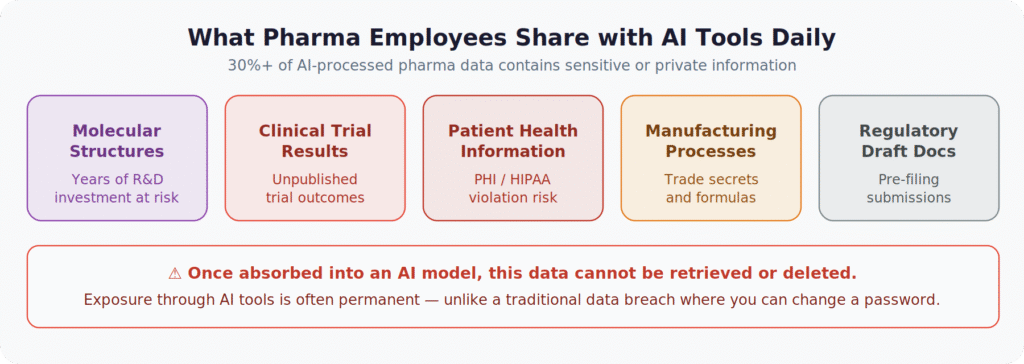
Infographic 2: What Pharma Employees Share with AI Tools Daily
Five Real Problems the Industry Keeps Running Into
1. Shadow AI Is Invisible to Compliance Teams
Most pharma compliance teams have no visibility into which AI tools their employees are actually using. Studies suggest 98% of organizations have staff using unsanctioned applications, with each organization averaging around 1,200 unofficial apps in active use.
The tools change constantly. New AI platforms appear faster than internal policy cycles can track. By the time a compliance team discovers a violation, the data has already been absorbed. This is why Security & Risk Audits have become increasingly important — they help surface the blind spots that internal teams are not positioned to find on their own.
Relevant RxCloud service: Security & Risk Audits
2. Third-Party Partners Multiply the Risk Significantly
Modern drug development does not happen inside a single company. It involves CDMOs, CROs, academic partners, and technology vendors — each of them a potential point of AI-related data leakage.
When a CDMO employee uploads jointly-owned clinical data into a public AI tool, the originating pharma company is also exposed — regardless of their own internal policies. According to Verizon’s Data Breach Investigations Report, third-party involvement in breaches doubled from 15% to 30% in a single year.
Relevant RxCloud services: GMP Audits · GCP Audits
3. Regulations Are Tightening Faster Than Companies Can Track
In 2024, US federal agencies issued 59 AI-related regulations — more than double the year before. Across 75 countries, legislative mentions of AI jumped by 21.3%. AI-related security incidents rose by 56.4% in a single year.
Pharma companies are simultaneously trying to comply with:
- HIPAA — requiring full audit trails for all electronic protected health information
- FDA 21 CFR Part 11 — demanding validated systems for any platform handling clinical data
- GDPR — mandating the right to delete personal data (which becomes technically impossible once data is embedded in an AI model)
- GxP guidelines — covering quality and process standards that most consumer AI platforms simply do not meet
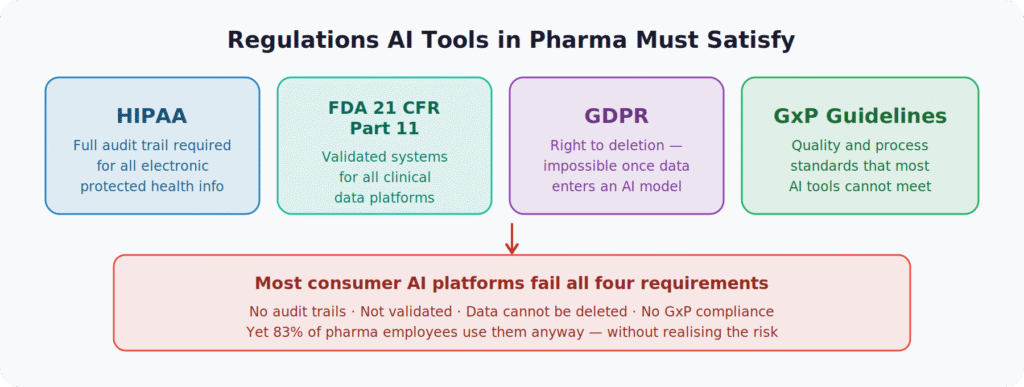
Infographic 3: Regulatory Frameworks AI Tools in Pharma Must Satisfy
When a regulator asks during an inspection how AI tools are governed and a company cannot produce documentation, “we didn’t know” is treated as negligence — not an excuse. Computer System Validation (CSV) is one of the core disciplines that addresses this directly.
4. Written Policies Cannot Block Real-Time Data Flows
A policy document does not stop anyone from pasting data into an AI tool under deadline pressure. Yet most organizations treat written AI usage policies as their primary protection mechanism.
Here is why that approach consistently fails:
- Policies cannot intercept data flows in real time
- Employees under pressure routinely bypass guidelines when AI offers an instant shortcut
- Consumer AI platforms evolve much faster than internal approval cycles
- Without technical enforcement, violations are invisible until after the damage is done
5. AI Audits Are Becoming a Regulatory Expectation
Regulators are beginning to expect pharma companies to produce structured evidence of AI governance during inspections. The questions they are asking include:
- Which AI tools are approved and in use across the organization?
- What data can those tools access?
- How are AI-generated outputs validated before they influence regulated processes?
- Who holds accountability when AI is involved in a decision?
Most companies today cannot answer any of these questions with documentation. Building that kind of structured audit readiness — something tools like RxAuditor are designed to support — is increasingly a baseline expectation, not a differentiator.
What Good AI Data Security in Healthcare and Pharma Looks Like
Closing the compliance gap requires a combination of structural and technical changes:
- Automated data classification — systems that recognize sensitive data in real time, before it leaves the organization
- Technical access controls — blocking unauthorized AI platforms at the network level, not relying on individuals to remember guidelines
- Validated AI workflows — ensuring any AI tool used in a regulated process meets 21 CFR Part 11 and GxP standards before deployment
- Continuous monitoring — tracking AI touchpoints across all systems, not just running annual reviews
- Third-party AI governance — applying the same standards to CDMOs and CROs that apply internally
- Audit-ready documentation — keeping structured records that can survive an FDA inspection, not reconstructing them after the fact
Frequently Asked Questions
What is AI data security in pharma?
It refers to the controls, frameworks, and technical systems that prevent sensitive pharmaceutical data — patient records, clinical trial results, molecular structures — from being exposed through AI platforms.
Why are 83% of pharma companies failing compliance standards?
Most rely on training and written policies rather than automated technical controls. As AI usage accelerates, human-dependent approaches cannot keep up. The compliance gap is structural, not a matter of individual carelessness.
Which regulations apply to AI in pharmaceutical companies?
The primary ones are HIPAA (patient data), FDA 21 CFR Part 11 (electronic clinical records), GDPR (EU data deletion rights), and GxP guidelines governing quality standards across pharmaceutical operations.
How can companies detect shadow AI usage?
Through network monitoring, IT security audits, and risk assessments. Identifying unsanctioned AI tool usage requires active investigation — it does not surface through standard compliance reviews.
Does RxCloud offer services relevant to AI compliance?
RxCloud’s services — including Security & Risk Audits, CSV, QA Consulting, and GxP audits — are relevant to pharma organizations building compliant AI environments. They address the compliance infrastructure gaps that make AI exposure possible.
The Bottom Line
Most pharma companies aren’t choosing to leave their data exposed. They simply haven’t measured how much exposure already exists. That’s the real problem hiding underneath the surface.
The fix isn’t waiting on new technology or bigger budgets. It’s already available, validated systems, structured audits, and proper governance frameworks that pharma companies can put in place today.
What separates the companies that will be fine from the ones that won’t is timing. Some will close this gap on their own terms, quietly and deliberately. Others will close it only after a regulator, a competitor, or a breach forces their hand. The data exists either way. The only question is who controls how the story plays out.