Computer Software Assurance: What Changed in the 2026 CSA Guidance RxCloud | therxcloud.com/computer-software-assurance-2026-update/ Most validation teams read the September 2025 guidance, updated their SOPs, and moved on. Then FDA replaced it four months later. On 3 February 2026, FDA issued a revised computer software assurance guidance. It superseded the September version and aligned the whole
Read More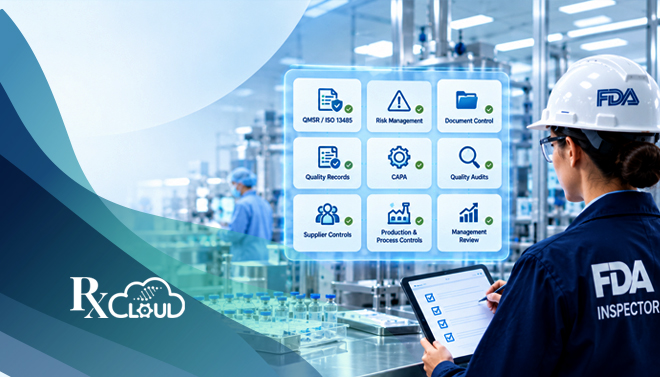
The grace period never existed. On 2 February 2026, the Quality Management System Regulation replaced the Quality System Regulation, and FDA began inspecting against it the same day. Seven months on, a pattern has emerged from early inspections. The firms struggling are not the ones with thin procedures. They are the ones who treated QMSR
Read More
AI has moved from slide decks to the shop floor. Cameras now inspect vials. Models flag deviations before anyone opens a batch record. And regulators have noticed. EU GMP Annex 22 is the first set of EU GMP rules written specifically for artificial intelligence in medicine manufacturing. If your quality team uses AI, or plans
Read More
A new kind of software is entering life sciences. It does not wait for a prompt. It plans, decides, and acts. This is why agentic AI in GxP has become one of the most urgent topics for quality and validation teams in 2026. These agents can move data, update records, and trigger workflows on their
Read More
Quality teams in life sciences are under more pressure than ever. Regulations keep shifting. Product pipelines keep growing. And reviewers are stretched thin. That’s why so many companies are moving from eQMS to Intelligent QMS. This shift isn’t just a buzzword. It’s a real response to real, everyday problems on the quality floor. In this
Read More
Can AI Systems Be GxP Compliant? AI is moving fast in pharma. Companies are using it for adverse event detection, clinical trial monitoring, regulatory submissions, manufacturing quality control, and more. But there is a question that keeps getting pushed to the side: can an AI system actually be GxP compliant? The short answer is yes,
Read More
Pharmaceutical companies are under enormous pressure to move faster. AI tools promise exactly that — quicker literature reviews, faster data analysis, sharper clinical insights. So employees use them. Every day, without much thought. And that is where the problem starts. A recent industry study found that only 17% of pharmaceutical organizations have automated controls to
Read More
If you are leading a life sciences organization in 2026, you are almost certainly using AI — or actively evaluating it. And if you are operating in a GxP-regulated environment, one question is unavoidable: how do I validate AI? It is the right question to ask. Knowing how to validate AI in pharma is no
Read More
As AI reshapes the life sciences industry, data security in the AI-driven environment has become the defining leadership challenge of our time. Every pharma executive, compliance officer, and quality leader is asking the same question: Can we trust AI with our most sensitive data? The answer is not a simple yes or no. It requires
Read More
Remote auditing (or e-auditing) is the practice of conducting compliance and quality audits entirely via digital tools, without auditors needing to be on-site. Auditors and clients meet in a virtual environment (for example via Microsoft Teams or Zoom) to share documents, interview staff, and review processes in real time. This method became widely adopted during
Read More