
A new kind of software is entering life sciences. It does not wait for a prompt. It plans, decides, and acts. This is why agentic AI in GxP has become one of the most urgent topics for quality and validation teams in 2026. These agents can move data, update records, and trigger workflows on their own. That power is useful. It is also a compliance risk you must control.
Traditional AI only answers a question. Agentic AI takes an action. In a regulated environment, a wrong action can affect patient safety, product quality, or data integrity. So the old validation playbook is no longer enough. This guide explains how to qualify AI agents safely, step by step.
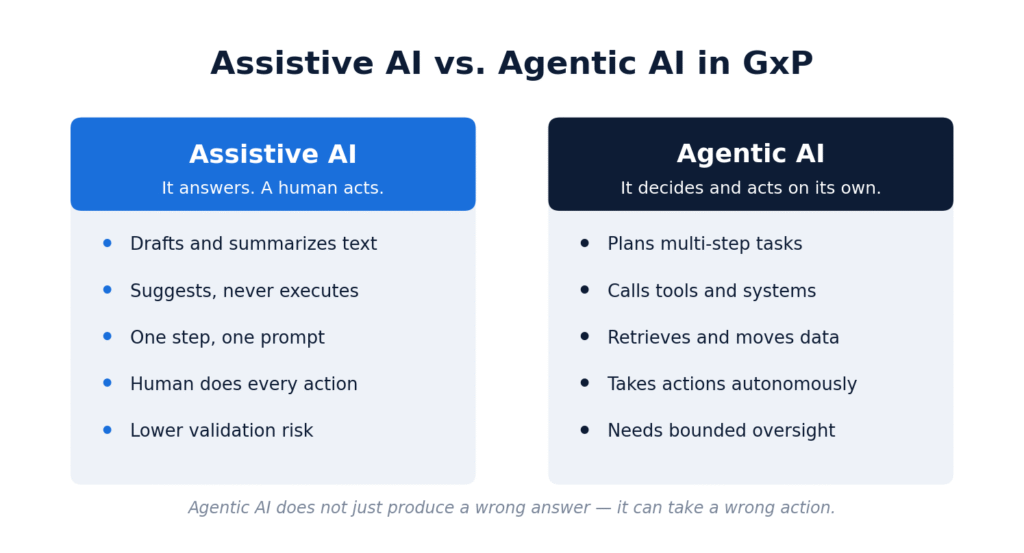
Figure 1: Assistive AI answers a question. Agentic AI decides and acts, which raises the validation stakes.
What Is Agentic AI? A Simple Explanation
Let us keep the agentic AI explained part simple. An AI agent is software that can reason toward a goal and then act to reach it. It does not just suggest text. It uses tools, calls other systems, and completes multi-step tasks with little human input.
Think of the difference this way:
- An assistant drafts a deviation summary and waits for you to use it.
- An agent reads the deviation, drafts the summary, files it in the QMS, and routes it for approval on its own.
Both are helpful. Only one takes independent action inside your regulated systems. That is the shift every quality team must now plan for.
Where Agentic AI Agents Help in GxP Today
Before we cover the risks, it helps to see the upside. Agentic AI agents are already saving hours of manual effort across quality and regulatory teams. The work is document-heavy and full of handoffs. That is exactly where agents shine.
Here are common, high-value use cases:
- Deviation and CAPA drafting. An agent reads the deviation, drafts the narrative, links related records, and prepares a CAPA plan for human review.
- Audit trail review. Agents scan large audit trails, flag unusual events, and summarise findings under ALCOA+ data integrity principles.
- Document authoring support. Agents help draft SOPs, protocols, and validation summaries, then route them into a controlled approval workflow.
- Regulatory dossier preparation. Agents assemble structured content for submissions, cutting the manual burden on regulatory teams.
- Vendor and risk assessments. Agents pull supplier data, prepare risk briefs, and highlight gaps for a qualified reviewer.
Used well, these agents remove repetitive work and free experts for higher-value tasks. The value is real. The challenge is keeping every one of these actions inside GxP guardrails. That is where validation comes in.
Why Agentic AI in GxP Needs a New Validation Approach
For years, teams validated software by testing fixed inputs and fixed outputs. An agent breaks that model. It can choose different paths for the same task. It can call tools you did not expect. It can chain actions together in new ways.
Regulators have noticed. The FDA and EMA published joint principles for good machine learning and AI practice in January 2026. In Europe, the draft EU GMP Annex 22 sets the first dedicated rules for AI in GMP manufacturing, with human oversight at its core. The message is clear. AI that acts must be controlled, testable, and traceable.
The Real Problems Teams Are Facing
These challenges show up again and again across regulated companies. You may recognise some of them.
- Shadow AI with no audit trail. Staff paste quality data into personal AI tools. Prompts and outputs are never captured. When an inspector asks what created a record, there is no answer.
- Actions no one can explain. An agent updates a record or closes a task. Later, no one can show why it made that choice or which data it used.
- No clear intended use. Teams deploy an agent broadly, without fixed scope. The agent then drifts into decisions it was never meant to make.
- Weak human oversight. Approval steps are skipped for speed. The agent acts on critical records with no documented human sign-off.
- Model drift over time. The agent performs well at launch, then quietly degrades. Without monitoring, the drop is caught too late.
Does RxCloud have a solution for these problems? Yes. RxCloud approaches agentic AI with the same rigour it brings to Computer System Validation. The focus is on intended use, risk, human checkpoints, and a complete evidence trail, so AI agents stay inside GxP guardrails.
How to Qualify AI Agents in GxP: A 6-Step Framework
You do not need to fear agentic AI. You need a repeatable way to qualify it. The framework below turns a complex problem into six clear steps.
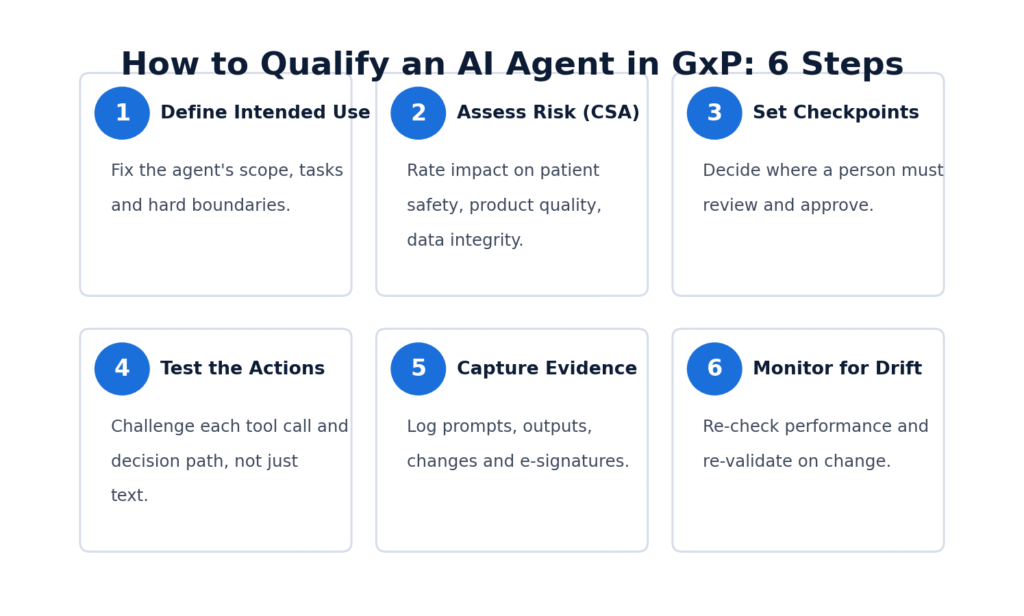
Figure 2: A six-step framework to qualify an AI agent for use in a GxP-regulated process.
Step 1: Define the Intended Use
Start by fixing what the agent may do. List its exact tasks. Set hard boundaries it cannot cross. A narrow, well-defined scope is the foundation of every validation activity that follows.
Step 2: Assess Risk With a CSA Mindset
Use a risk-based approach, in line with Computer Software Assurance. Rate each agent action by its impact on patient safety, product quality, and data integrity. High-impact actions get deep testing. Low-impact actions get lighter checks. This keeps effort where it matters.
Step 3: Set Human Checkpoints
Decide where a person must review and approve. Any action that touches a critical record should need documented human authorization. The agent may draft and prepare. A qualified human still owns the final decision.
Step 4: Test the Actions, Not Just the Answers
This is the heart of agentic validation. Do not only check the text an agent writes. Challenge every tool it calls and every path it can take. Test what happens when data is missing, when a step fails, and when the agent faces an edge case. You are validating behaviour, not just output.
Step 5: Capture the Full Evidence Trail
Every prompt, output, change, and approval must be logged and linked. Electronic signatures and audit trails still apply under 21 CFR Part 11, whether a human or an agent drafted the record. If you cannot produce a clean evidence package on request, you are not inspection-ready.
Step 6: Monitor for Drift and Re-Validate
Qualification is not a one-time event. Track the agent’s performance over time. Set thresholds that flag degradation. Re-validate when the model, data, or process changes. Continuous monitoring keeps the agent in a validated state.
Keeping the Human in the Loop
The goal is not to slow AI down. The goal is to make the safe path the easy path. When governance lives inside the workflow, teams get speed and control together. That balance is exactly what modern GxP audit and quality engineering services are built to support.
Agentic AI can draft impact assessments, prepare CAPA plans, and organise audit evidence. Used well, it removes hours of manual work. Governed poorly, it creates records no one can defend. The difference is the framework you put around it.
The 2026 Regulatory Landscape for Agentic AI
Rules for AI in life sciences are maturing fast. You do not have to master every clause. You do need to know the three frameworks that shape agentic AI in GxP and what each one expects.
EU GMP Annex 22
Annex 22 is the first dedicated EU GMP framework for AI in medicines manufacturing. The draft was published in July 2025, and a final version is expected in 2026 with a grace period. As drafted, it focuses on static, deterministic models for critical use, and it keeps generative and adaptive models in non-critical roles under human oversight. It places full responsibility for validation evidence on the regulated company.
FDA and EMA Joint AI Principles
In January 2026, the FDA and EMA published joint principles for good AI practice in drug development. This gives the first transatlantic alignment on AI validation, human oversight, and traceability. It signals that regulators expect an auditable chain of reasoning for every decision an agent influences.
21 CFR Part 11 and Data Integrity
These long-standing rules still apply. Records and signatures created with AI help must remain attributable, legible, contemporaneous, original, and accurate. An agent does not get an exemption because it is new technology.
The table below shows how validation expectations shift as software becomes more autonomous.
| Dimension | Traditional Software | Assistive AI | Agentic AI |
|---|---|---|---|
| Behaviour | Fixed and predictable | Suggests content | Plans and acts on its own |
| What you test | Inputs and outputs | Output quality | Actions and decision paths |
| Human role | Operates the system | Uses the suggestion | Approves critical actions |
| Key risk | Config errors | Wrong answer | Wrong action |
| Monitoring | Periodic review | Output checks | Continuous drift checks |
Table 1: As software gains autonomy, validation shifts from testing outputs to testing actions.
Common Mistakes to Avoid
Most agentic AI failures are not technical. They come from weak governance. Watch for these mistakes.
- Treating a policy as a control. A written policy no one enforces does not govern anything. Controls must live inside the workflow.
- Banning AI outright. If the approved path is blocked, staff use shadow tools. Make the safe path the easy path instead.
- Assuming enterprise AI equals compliance. An enterprise licence protects data, but it does not create GxP evidence on its own.
- Validating once and forgetting. Agents drift. A one-time qualification is not enough without ongoing monitoring.
- Skipping human sign-off for speed. Critical actions always need documented human authorization, no matter how fast the agent is.
Frequently Asked Questions
What is agentic AI in GxP?
Agentic AI in GxP is AI that can plan and take actions inside regulated life sciences workflows, not just answer questions. Because it acts on records and systems, it must be qualified with clear intended use, human oversight, and full audit trails.
How is agentic AI different from a normal AI assistant?
An assistant suggests content and waits for a human to act. An agent completes multi-step tasks on its own, such as retrieving data, updating records, and routing approvals. This autonomy is what raises the validation and compliance stakes.
Do you still need 21 CFR Part 11 controls for AI agents?
Yes. Electronic records and signatures created or influenced by an AI agent must still meet 21 CFR Part 11 and data integrity expectations. Prompts, outputs, reviews, and approvals should all be captured in the system of record.
How do you validate agentic AI agents?
You validate them by defining intended use, assessing risk, setting human checkpoints, testing the agent’s actions and decision paths, capturing an evidence trail, and monitoring for drift. Testing behaviour matters as much as testing output.
What is EU GMP Annex 22?
Annex 22 is the first dedicated EU GMP framework for artificial intelligence in medicines manufacturing. It focuses on static, deterministic models for critical use and requires human oversight, with a final version expected in 2026 followed by a grace period.
Which GxP tasks can agentic AI agents support?
Agentic AI agents can support deviation and CAPA drafting, audit trail review, SOP and protocol authoring, regulatory dossier preparation, and vendor risk assessments. Each of these still needs human review before the output becomes a controlled record.
Can RxCloud help validate AI agents in GxP?
Yes. RxCloud brings a risk-based, CSA-aligned approach to qualifying AI agents, backed by deep experience in GxP audits, computer system validation, and quality engineering across life sciences.
Ready to deploy agentic AI without losing control?
Agentic AI is moving fast. Your validation approach should move with it. RxCloud can help you qualify AI agents that are compliant, testable, and inspection-ready, so you innovate with confidence. Talk to RxCloud today and build your agentic AI validation strategy.